
Chafing Dish Wind Guards: Why Half Your Sterno Flames Go Out at Outdoor Events

Last updated: October 18, 2026. Now includes wire cage vs. acrylic comparison, the 6 functional benefits of acrylic wind guards, and a 7-question FAQ with food safety temperatures.
Why Half the Outdoor Catering Sterno Flames Go Out by Hour Two
If you've worked an outdoor wedding, a rooftop corporate event, or a tented venue in shoulder season, you already know this story. The chafing dishes look perfect at setup. By the time guests are eating, half the sterno cans are sputtering or out, the food is cooling fast, and someone from the team is flicking lighters and shielding flames with a tray while pretending nothing is wrong.
The problem is not the sterno. The problem is that nothing stops the wind from hitting it.
A standard gel fuel canister flame is stable in still air, but a 5 mph breeze is enough to push it sideways and break the combustion. At outdoor venues, that threshold is crossed constantly. In tented events, the tent funnels outside air through the open sides faster than the ambient wind speed. On rooftops, there is no buffer at all. The result: the sterno goes out, the water in the lower pan cools, and food temperature drops below the FDA's 140°F holding threshold within 20 to 30 minutes.
A chafing dish wind guard solves that. This guide covers what it is, when you need it, how the two main types compare, and how to pick the right one for a catering operation.
The actual problem: food safety + service cost
Cold food at a catered event is not just a quality issue. It is a food safety and business exposure issue with a specific number attached.
The FDA Food Code requires hot food to be held at or above 140°F. A properly fueled chafing dish maintains the lower pan water at 180-190°F, keeping the food pan in the 140-160°F range. When the flame goes out unnoticed during a 200-person plated service, food in that pan spends 20 to 30 minutes in the temperature danger zone (40-140°F) before anyone relights the can. Guests at the end of the line get food that has been sitting in that zone the entire time they waited.
The downstream cost is concrete. A partial refund or service credit at a $40,000 wedding reception runs $500-$2,000 depending on what was agreed. One cold-food complaint to the venue coordinator affects the referral relationship, not just the event invoice. For an operation running 60 outdoor events per year, even one refund per quarter wipes out the cost of a full wind guard kit several times over.
The re-light problem compounds this. Every time a team member relights sterno near guests, it creates a visible service break. They are leaning over buffet dishes with a lighter, shielding the flame with a hand, sometimes asking guests to step back. That 90-second sequence is something guests notice and remember. Wind guards prevent the situation entirely.
When wind matters most
Not every venue requires wind guards. An enclosed hotel ballroom with controlled air circulation and no drafts from doors is usually fine. The test is simple: at counter height, can you feel air movement near where the chafing dishes will sit?
Venues where the answer is consistently yes:
- Outdoor weddings, even on calm days. Ambient outdoor air is almost never truly still. Ceremony timing and photo sessions mean guests cycle in and out of a buffet area for an extended window. A flame that held at noon may not hold at 3 pm if cloud cover shifts and a breeze picks up.
- Tented events. Tent walls channel outdoor air through the open sides in a way that concentrates wind speed at table height. The flame condition inside the tent is often worse than the ambient outdoor wind reading.
- Rooftop venues. Rooftops are exposed at height. A 7 mph street-level breeze translates to 12-15 mph at rooftop level. No standard sterno setup holds reliably at those conditions without shielding.
- Beach and waterfront locations. Consistent cross-drafts, often with salt particulate that accelerates corrosion on wire guards.
- Hotel ballrooms near exterior doors or loading corridors. Every time a door opens for a kitchen run, a gust crosses the buffet. Events where the kitchen door opens 30 times per hour need wind guards on every station near that sightline.
- Breakfast buffets near lobby doors. Morning events in hotels often position the breakfast station near the main entrance. Foot traffic through lobby doors creates a repeating cycle of air displacement directly across the chafing dishes.
- Loft and warehouse spaces with high ceilings and ceiling fans. Industrial venues with open ceiling fans create circulation patterns that are unpredictable at table height. HVAC supply vents directed at buffet lines in these spaces behave like outdoor wind in their effect on the flame.
Wire cage vs. acrylic: what actually works
Two designs dominate the market. Understanding the tradeoffs determines which one belongs in a specific operation.
Wire cage wind guards
Wire cages are the original solution. A rectangular wire frame, usually steel or chrome-plated steel, surrounds the base of the chafing dish to block airflow to the fuel canisters. They are inexpensive, widely available at restaurant supply houses, and take direct heat without degrading.
The drawbacks accumulate quickly in a styled catering context. Wire interrupts sightlines. Guests and photographers see the mechanical infrastructure of the station rather than the food. Chrome wire shows rust spotting after repeated commercial dishwashing at high temperatures, usually within 12 to 18 months of regular use. At higher-end events, wire cages look utilitarian in a way that conflicts with the visual standard the client paid for.
Wire cages work well for institutional settings: hospital cafeterias, corporate cafeteria lines, high-volume hotel breakfast stations where appearance is secondary to durability and cost. They are not the right choice for weddings, private events, or any context where the buffet presentation is part of what was sold.
Acrylic wind guards
Clear acrylic guards address every limitation of wire cages while maintaining the same core function: blocking the draft from reaching the fuel canisters.
The material is flame-polished on the edges, transparent at a 6mm panel thickness, and holds its shape through the heat range generated by sterno combustion. The panels clip or snap to the chafing dish frame with embedded magnets, requiring no tools and no mounting hardware. A full set of 4 panels installs in under 30 seconds per guard.
Rectangular acrylic guards pack flat. Six stack to roughly the same footprint as two wire cages in disassembled form. Round guards do not pack flat, they nest inside each other like stacked half-moons. In a catering van or transport case, that difference across a 10-guard kit is an entire shelf of space.
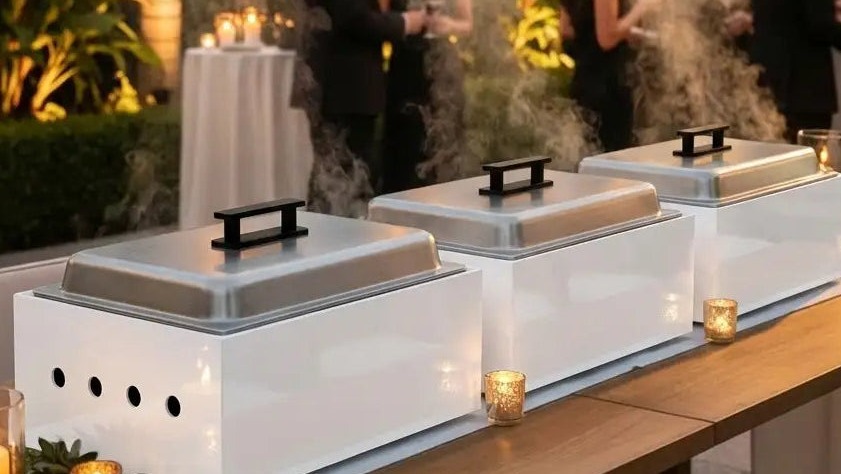
The visual result is a buffet that looks clean. Guests see the chafing dish, the food, and the linens. They do not see the wind protection. The guard is doing its job invisibly, which is what catering equipment is supposed to do.
The 6 functional benefits of acrylic wind guards
For catering operations evaluating whether to standardize on acrylic, these are the six reasons the category has replaced wire cages at most mid-to-upper market operations over the past decade:
- Flame protection that holds through a full service run. Acrylic panels block the horizontal draft that wire cages partially address. Because the panels enclose the base continuously rather than through open mesh, the effective shielding at the fuel canister is more complete. A station with acrylic guards can hold a sterno flame in conditions that blow out a wire-caged setup.
- Heat retention through the 140°F threshold. The enclosed base creates a microclimate that keeps heat concentrated around the fuel canister and lower pan, rather than allowing convective heat loss to the ambient air. In cold-weather outdoor events below 50°F, this matters significantly. The heat retained extends burn time and keeps water temperature more consistent.
- Pack-flat folding for transit. Panels separate and lay flat, so a 4-panel set for one chafing dish occupies the same case space as a few cutting boards. Wire cage disassembly is awkward; acrylic guards are purpose-designed for flat transit.
- Magnetic assembly with no tools. The embedded magnet system in commercial-grade acrylic guards means setup is one motion per panel. No threading wire ends through frame slots, no tightening clips. Useful at 6:30 am for a hotel breakfast setup when the team is assembling 12 stations in 40 minutes.
- Modular sizing for mixed station configurations. Rectangular and round guards are separate SKUs. A caterer running both chafer shapes can carry exactly the mix they need rather than over-buying one format to cover both.
- Aesthetic compatibility with high-end events. Clear acrylic in polished finish reads as part of the table design, not as utility equipment. Black acrylic guards are available for black-and-gold event themes where the guard becomes a deliberate visual element. Wire cages do not offer this kind of aesthetic alignment.
How to choose the right wind guard for a catering operation
Five questions to work through before purchasing:
What types of events does the operation run? If the calendar is primarily outdoor or tented events, full acrylic coverage on every hot station is the baseline. If 80% of events are hotel ballroom, a smaller acrylic kit supplemented by awareness of which ballrooms have HVAC vent placement near buffets covers most scenarios.
What chafer shapes are in the current inventory? The rectangular guard fits most 8-9 quart rectangular chafers. Count your rectangular and round chafers separately. Buy one guard per frame, plus 25% spare inventory for cracks and misplaced pieces.
Is appearance at events part of the brand standard? If the operation pitches styled buffets or is regularly booked for weddings and private social events, acrylic is the correct choice. Wire cage is appropriate only if the operation works primarily in institutional food service settings where visual standards are not a differentiator.
How is equipment transported? If the operation uses a transit case or van shelving, flat-packing rectangular guards are easier to stow than wire cages in any quantity above 4. If the operation ships equipment by pallet to convention centers, wire cage durability during rough transit may be relevant.
What is the event temperature range? Below 45°F outdoor ambient, the insulating effect of the enclosed acrylic base adds measurable hold time to the sterno burn. If the operation runs November and December outdoor events in a cold-weather market, that factor is worth weighing against the incremental cost of acrylic over wire.
Setup order at the venue
Wind guards go on before the fuel is lit. The correct sequence at each station:
- Linen on the table
- Chafing dish frame assembled
- Wind guard panels snapped on (10 seconds)
- Sterno or fuel canisters placed and lit
- Water pan filled
- Food pan inserted
- Food added
Installing the guard before lighting fuel keeps the install sequence dry, avoids reaching around an open flame, and means the shielding is in place from the first moment the flame is burning. Teams that install guards after lighting frequently skip them under time pressure. Making guard installation a pre-lighting step removes that decision point from a busy setup window.
How many you actually need
The working rule is one guard per hot station plus 25% spares.
- Entry kit (3-4 stations): 5-6 guards covers active stations with one or two spares.
- Standard working kit (6 stations): 8 guards. Enough for a full buffet setup plus two spares for cracks or misplaced pieces at breakdown.
- High-volume operations (simultaneous events or 8+ station setups): 12-16 guards. The spare calculation changes when guards might be at two venues on the same day.
For the cost math: a commercial-grade acrylic guard runs $99 to $200 depending on size and finish. A single partial refund on a cold-food complaint at a $20,000 event typically costs $500-$1,500. The math closes quickly.
The Plinths New York (plinthsny.com) wind guard line
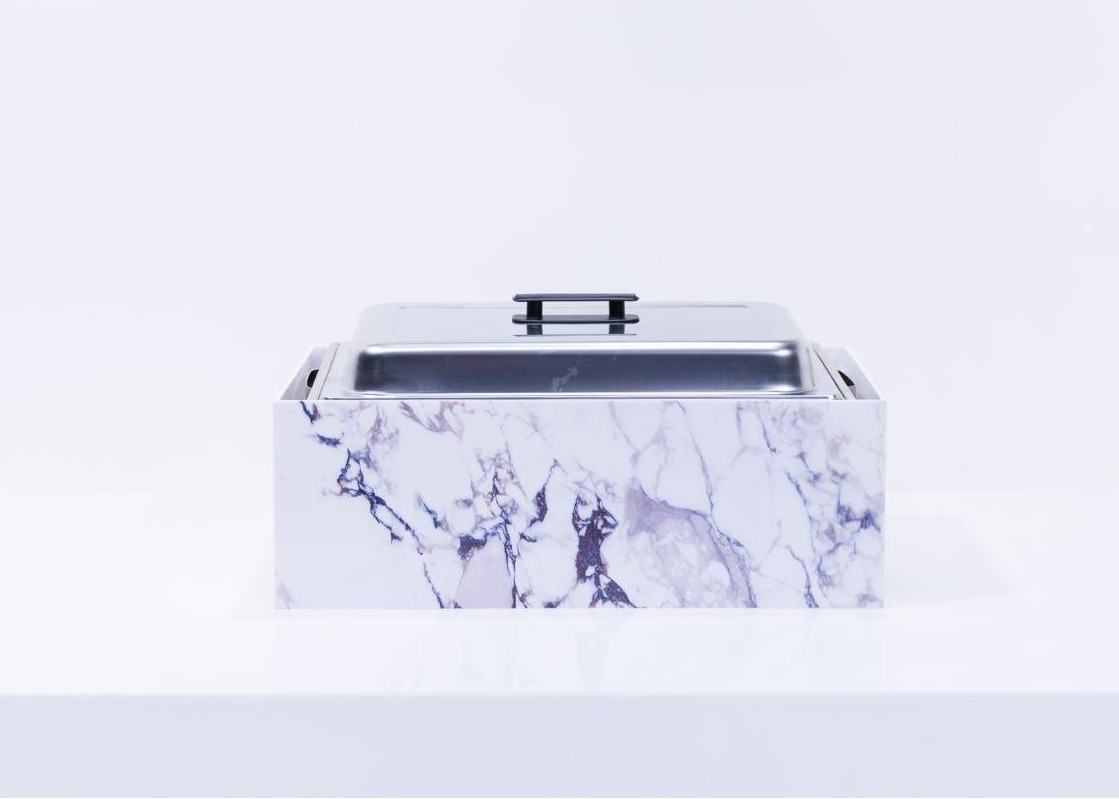
The magnetic chafing dish wind guard from Plinths New York comes in clear, black, gold, and silver acrylic. Panels are 6mm commercial-grade acrylic with flame-polished edges and embedded magnets that snap to standard chafing dish frames with no tools. Both rectangular and round formats are available.
The guard pairs with acrylic buffet risers for stations that need height variation, and with black acrylic plinths for evening setups where the chafing dish frames sit on a coordinated base.
What Plinths New York does not offer is a wire cage, and that is deliberate. The operations that stock this line are running events where the presentation is part of what was sold to the client. Wire cages are available from every restaurant supply house. Acrylic guards designed to disappear into a styled buffet are a different category, and that is the one this line is built for.
Frequently asked questions
What is a chafing dish wind guard?
A chafing dish wind guard is a transparent acrylic panel that wraps around the open base of a chafing dish, sitting between the frame and the fuel canisters. It blocks cross-drafts that extinguish gel fuel flames in outdoor or semi-open environments. Magnetic guards snap to the chafing dish frame without tools, installing in about 10 seconds per unit.
At what wind speed does a sterno flame blow out?
A standard sterno gel fuel flame can be disrupted by breezes as low as 5 mph when the canister has no shielding. At outdoor weddings and tented events, even calm-day conditions often exceed that threshold near tent openings or buffet lines positioned across a room from HVAC supply vents.
What temperature does food need to stay above in a chafing dish?
Hot food must stay at or above 140°F (60°C) per the FDA Food Code. A chafing dish with an active flame holds water in the lower pan at roughly 180-190°F, keeping the food pan in the 140-160°F range. When the flame goes out, the water cools within 20-30 minutes and food temperature drops toward the danger zone below 140°F.
Are wire cage wind guards or acrylic wind guards better for catering?
Acrylic guards are the better choice for most catering operations. Wire cages are inexpensive but block sightlines, show rust after repeated commercial washing, and look utilitarian at styled events. Clear acrylic guards are invisible to guests, store compactly, and hold their appearance through repeat service. Wire cages still make sense for institutional food service where appearance is secondary to cost and durability.
Do chafing dish wind guards work for both rectangular and round chafers?
Plinths New York makes two guard formats. The rectangular guard measures 24 x 14 x 9 inches overall and fits most 8-9 quart rectangular chafers. A separate round guard covers round chafers. They are sold as separate SKUs because the panel geometry differs. Measure your chafer before ordering.
How many chafing dish wind guards does a catering company need?
One guard per hot station is the minimum. For a working kit running 3-4 stations per event, 5-6 guards cover the stations plus one or two spares. Operations running simultaneous events or 6-station setups should carry 10-12 guards. Add 25% to your active station count to account for cracks, guards left at venues, and double-event days.
Can chafing dish wind guards be used indoors?
Yes. Hotel ballrooms with HVAC supply vents near the buffet line, loft spaces with ceiling fans, and any venue with active doors near the food stations benefit from wind guards indoors. If you can feel air movement at counter height near the chafing dishes, guards prevent the same extinguishing problem that happens outdoors.
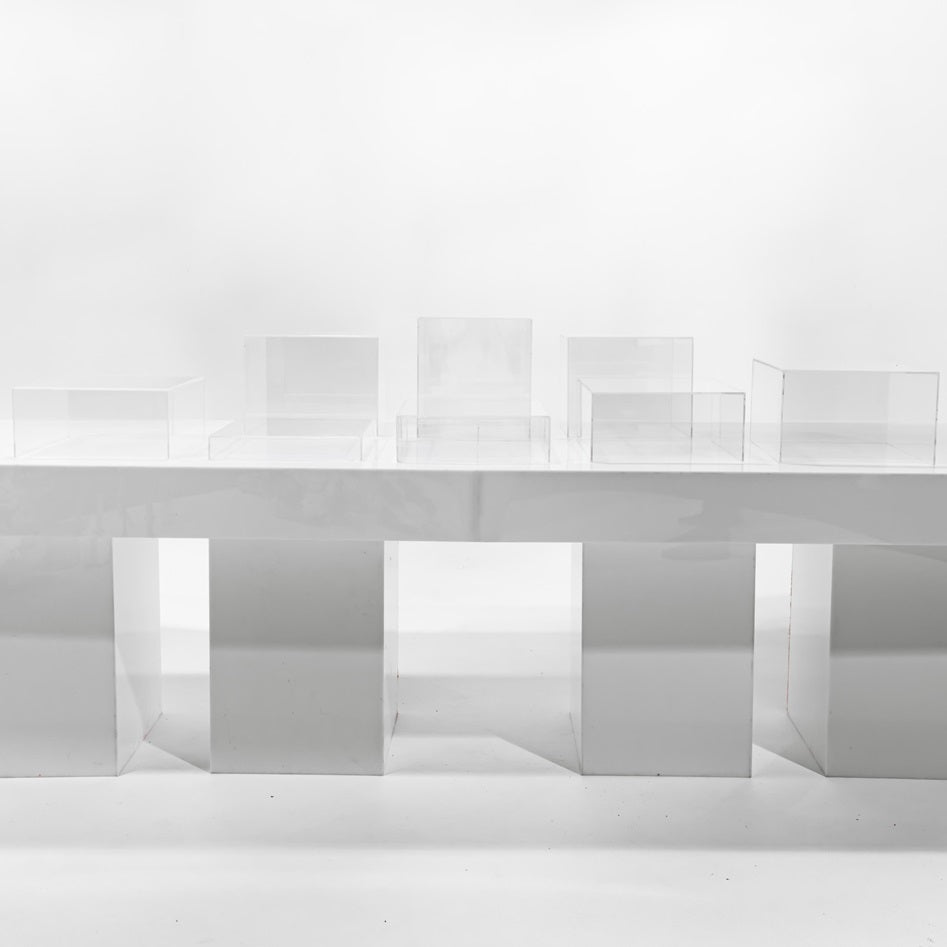
Related: For all-white setups specifically, see our white acrylic risers collection: flagship 15-piece set, ribbed duo, and oval tier in matched footprints.
Related: For all-white setups specifically, see our full acrylic risers collection: white, black, clear, and mirrored finishes in matched-footprint sets.